More demand than capacity
Every commitment consumes attention, time, and resources that cannot be spent twice.
We help leadership teams set clear priorities, align plans and commitments around them, and adapt coherently as conditions change. The Priorities.ai platform keeps what you decided and why, so change is a decision, not a drift.
What the organization is trying to accomplish
What deserves attention and resources now
How the priorities will be advanced
The owned decision that creates action and preserves alignment as it changes
Attention, resources, and work can move with confidence.
Work carried out against the current commitment
The enduring condition
Naming the top five is not the hard part. The hard part is that they compete for the same finite capacity, depend on one another to land, and rest on evidence that keeps moving.
Every commitment consumes attention, time, and resources that cannot be spent twice.
Priorities originate across functions, then compete, depend on one another, and move through the same constrained system.
Plans have to move. The challenge is changing them without creating contradictory commitments or fragmented execution.
What a client noticed
Someone was not in the room. Something was lost in the retelling. A commitment moved through three layers, and nobody downstream knew what else it touched. The list made it across the organization. What made the list did not.
01What people think the list is
02What the list really is
03What Priorities.ai does
01What people think the list is
02What the list really is
03What Priorities.ai does
The context around that list is almost as important as the list, for people to buy into the list.
Good prioritization creates commitments for action. And alignment through change.
Commitment provides enough clarity and conviction to move. Coherence keeps the organization coordinated as priorities, plans, and commitments evolve.
Two dimensions of coherence
A decision can drift as it moves across the organization or fracture when it changes over time. Priorities.ai preserves the connections in both directions.
↑ why this exists↓ what it means here
Keep the meaning intact across levels and functions.
Teams can see how their commitments connect to the priority above them and the work beneath them.
Plan 01
Plan 02
Recorded with the changeCapacity fell 20%. Narrowed rather than dropped — the earlier plan stays on the record.
Change the plan without losing the organization.
When leaders revisit a priority or plan, revised commitments propagate with their rationale and history.
01What we establish
We work with leaders on the conditions around the decision as well as the decision itself.
What arrives
Every one legitimate. All drawing on the same people.
What holds
Everything else: held below the line, on the record.
Clarify what each item is, the level at which it belongs, and the dependencies, conflicts, bundles, and sequences that shape the portfolio.
Use broad input where it improves the decision, distinguish values from beliefs, and make clear who has authority to commit the organization.
Connect the priority to a plan, an owner, a rationale, and the work it authorizes so that execution has a stable reference point.
When leaders revisit priorities or plans, revise the resulting commitments deliberately and carry the change through the organization without losing alignment.
02How we think
Values determine what is worth doing. Beliefs determine what can be done and what it may achieve. The ranking is the arithmetic of what went in.
03The record the work runs on
Every engagement runs on Priorities.ai, a shared record of what your organization decided: what it committed to, which commitments conflict, who may change them and why, and whether the work in progress still matches.
| Job | How it works | Without it |
|---|---|---|
| Records commitments | Direction and requests become a short, ranked list of commitments. | Every request competes as a priority. |
| Surfaces conflicts | Commitments that need the same people, budget or time are flagged before work starts, for the accountable people to resolve. | Conflicts appear partway through delivery. |
| Controls changes | Each commitment names who may change it. Changes go through that person and are recorded. | Plans change without a record of who changed them, or why. |
| Keeps the reasons | The criteria and evidence behind each decision stay attached. Earlier versions remain on file. | Settled questions are reopened because the reasoning is lost. |
| Checks the work | Work in progress is compared with what was decided. | Differences surface only after delivery. |
What it looks like
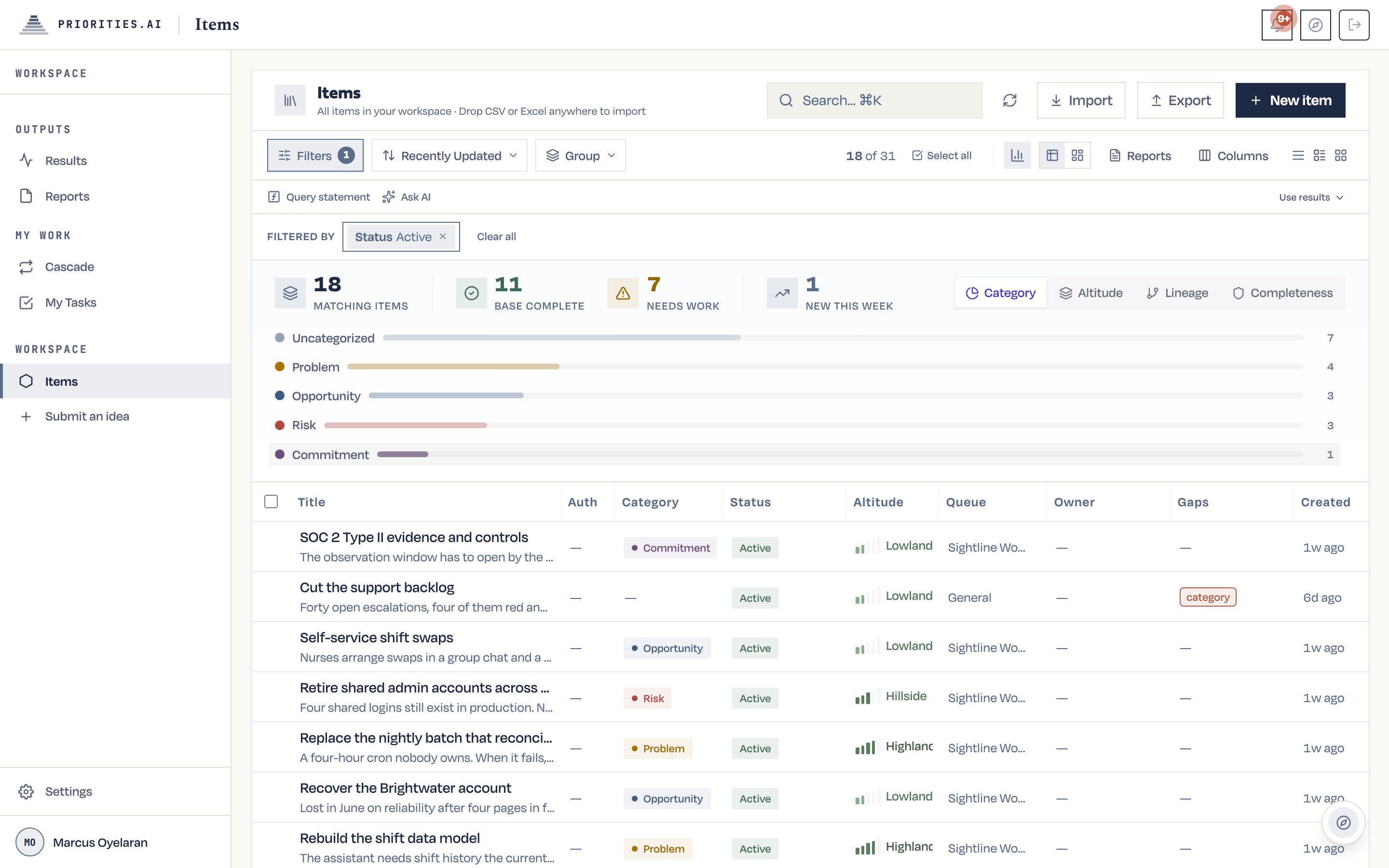
The record
Every item, its category and altitude, who owns it, and what it still needs before it can be compared.
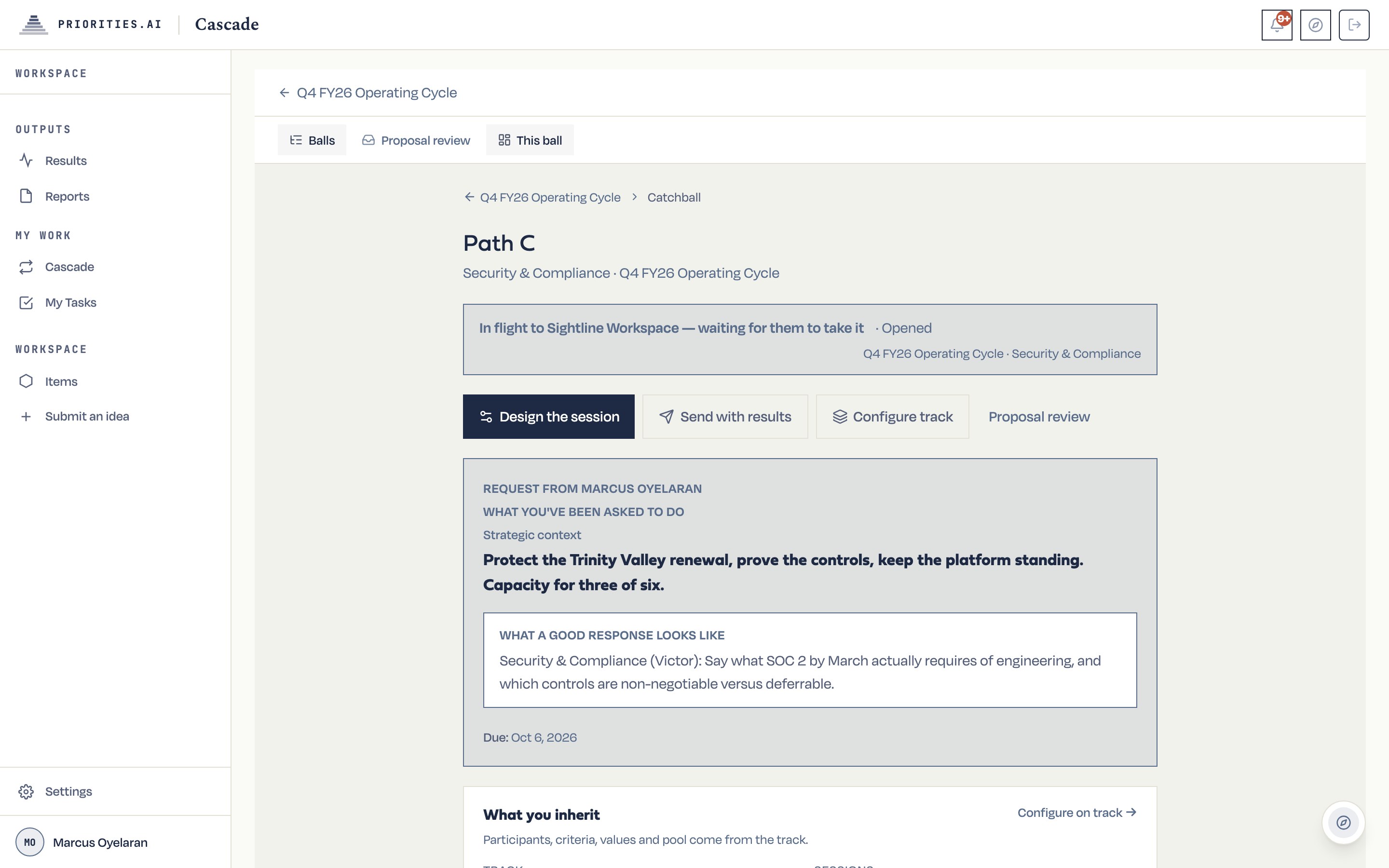
Catchball
Requests go down, proposals come back up. Each loop is on the record until leadership answers.
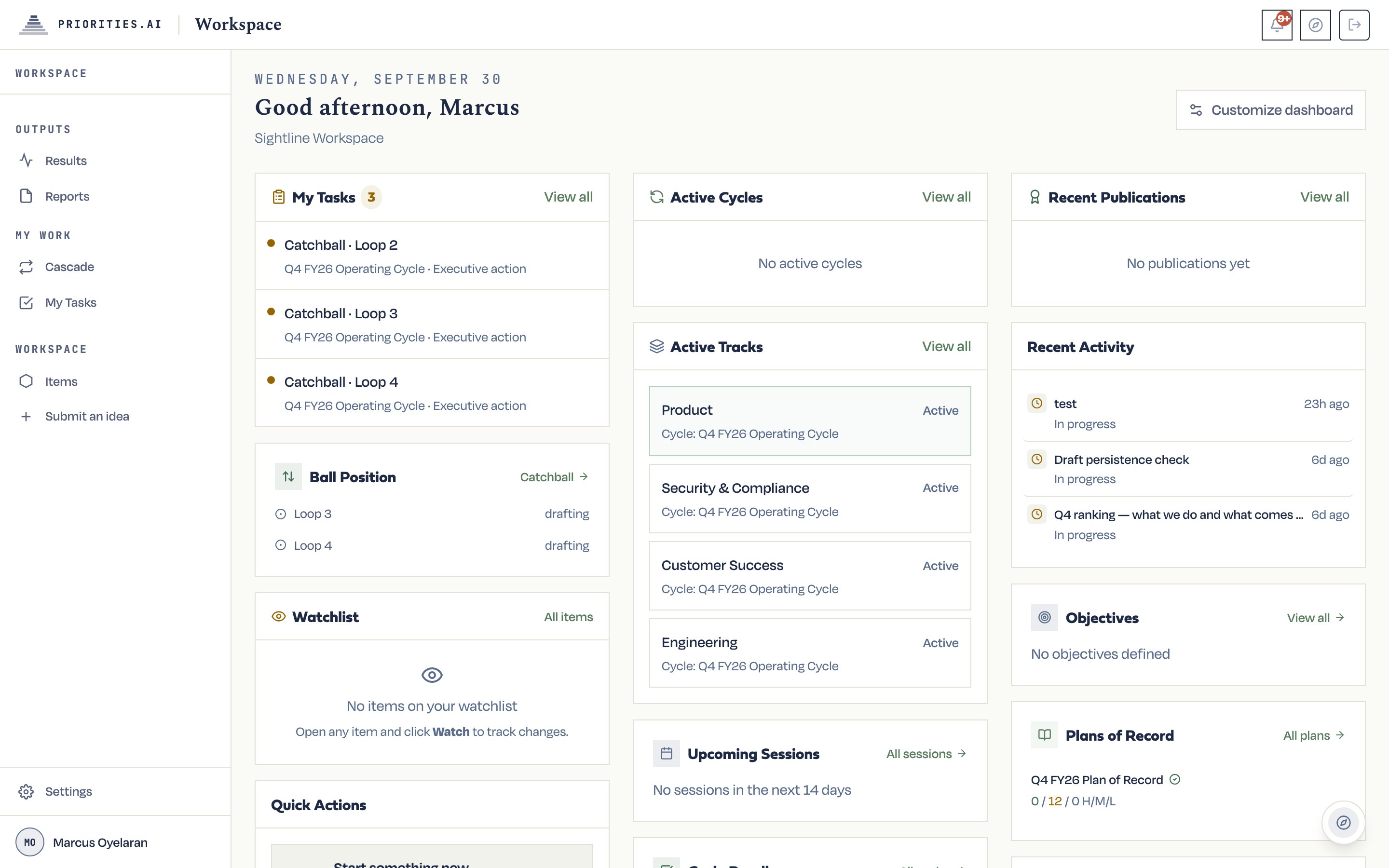
A working day
What needs attention now, what is in flight, and what changed since you last looked.
How it comes to you
Configured to how your organization actually decides: your cycles, your criteria, who holds authority where — connected to the systems your teams already work in.
Your first cross-functional decisions go through it, facilitated with your leaders and teams, until the method belongs to the people using it rather than to us.
Licensed to you and operated by your team, with the record of every decision made along the way. We stay involved at whatever depth you want — including none.
Decision infrastructure
Org charts distribute authority and expertise. They do not, by themselves, make decisions hold together across the lines they draw.
Scroll sideways to see the whole drawing.
We believe an organization needs one shared way of describing the work it is weighing and the work it has promised: the items, how they rank, how they relate, who decided, why, and what was committed. An item is an item in every part of the company. A rank is a rank. A commitment is a commitment. The words mean the same thing everywhere, and a decision about one carries its consequences to everything it touches.
That shared foundation is what makes freedom possible. Functions, business lines, and teams can plan and prioritize their own way, with their own methods, and still read one another's priorities, dependencies, and commitments. Autonomy works when a team can see the obligations that connect its work to the rest and honor them, and when a commitment can change without its reasons disappearing.
The AI in Priorities.ai
They shape what arrives, red-team the ranking before you publish, and watch the plan after you do: execution drift, rules bypassed, the outside world touching what you committed to.
Classifies, de-duplicates, and structures what arrives, from notes, dictation, or a spreadsheet.
Knife-edge margins, buried dissent, priorities that serve no objective, the one item that unblocks everything.
Execution drift, rules bypassed, the outside world touching your plan, and every review date the record set for itself.
04Why now
AI expands what an organization can do faster than it expands the ability to decide what deserves attention, resources, and commitment.
It can strengthen evidence and update beliefs. It cannot determine what the organization should value or who has authority to commit it.
AI does not create the problem. It increases the cost of leaving priorities, plans, and commitments disconnected.
What AI lets you start
What the organization has actually committed to
05Who we work with
Our work is most useful when all four of these are true.
| What is true | What people say | |
|---|---|---|
| 1st | Priorities are revisited throughout the year, across several teams. | “We re-plan every quarter, and every department has a stake in it.” |
| 2nd | The people doing the work are not the people setting direction. | “Leadership sets the direction. Forty teams carry it out.” |
| 3rd | Changing course happens often, and each change is costly. | “Every shift costs us weeks of rework.” |
| 4th | Leadership values alignment over keeping every option open. | “I would rather we all move in one direction.” |
Work directly with your leadership team on the prioritization system, a consequential portfolio, or a decision that will travel across the organization.
Explore consulting →Working sessionBring the people, the work, and a live decision. Leave with a shared frame, explicit tradeoffs, and commitments the organization can carry forward.
Explore workshops →Ongoing practiceBuild the judgment, routines, and governance needed to keep priorities, plans, and execution connected over time.
See ways to work together →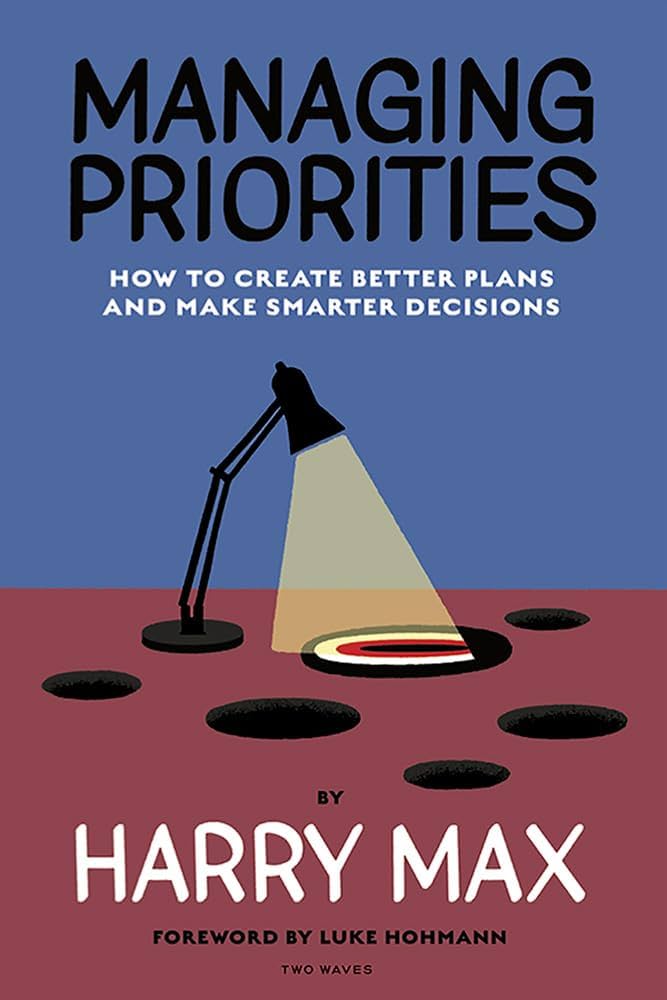
The foundation
Our work builds on Harry Max’s Managing Priorities and decades of helping leaders make difficult choices with greater clarity, rigor, and follow-through.
Peak Priorities brought clarity to an emotionally complex decision, turning vague aspirations into a concrete framework with measurable milestones.




















Peak Priorities